- The Publisher Newsletter
- Posts
- The challenges of print magazine publishing
The challenges of print magazine publishing
Whatever the talk of a print revival, no one would pretend that publishing a printed title is without its challenges. Peter Houston breaks them down, and what to consider to overcome them.


Media Voices & Peter Houston
March 31, 2026
Welcome to the Publisher Newsletter by Media Voices: profiling the people and products powering publishing.
- ad -

The zero-click era is changing how audiences discover and consume content, with platforms like Google, social feeds, and AI assistants increasingly delivering answers without users visiting websites.
This short survey aims to understand how this shift is impacting publishers. Your input will help identify emerging trends, challenges, and opportunities and will be part of a new report we’re writing about the zero-click era.
Participants will receive early access to the research findings and be entered into a draw to win one of five €50 Amazon vouchers. Responses will remain confidential and anonymized.

The challenges of print magazine publishing
Whatever the talk of a print revival, no one would pretend that publishing a printed title is without its challenges. Peter Houston breaks them down, and what to consider to overcome them, in this feature from our report into The Print Revival.
Individual titles with their own unique audiences will face their own obstacles, but here is a look at some of the common hurdles we see for publishers looking to take advantage of the print opportunity.
Real-world costs
Making a magazine costs money. More than that, the costs are completely visible. Where the costs of digital publishing infrastructure and content creation can be difficult to separate out at a brand level, print magazines can be accounted for down to individual pages.
Worse, costs in the real world are increasing. Paper costs rose through the pandemic as paper mills switched to cardboard to supply the home-delivery boom. Simon Freeman at LTW told me, “There was a point where we were facing paper price increases of 30% every time we printed.” Rising energy tariffs over the last couple of years have also hiked up printing and distribution costs.
And for any publisher that wants to sell on the newsstand, simply being in mass-market retail or on supermarket shelves has a cost. Distributors often keep more than 50% of the cover price and supermarkets charge a substantial listing fee.
It’s little wonder Monocle founder Tyler Brûlé says magazines don’t have a print problem, they have a distribution problem.
Consider: Reducing print frequency, upping publication quality and instituting premium pricing. Giving readers more but less often can help cement reader loyalty at the same time as mitigating increasing production and distribution costs.
Advertising alternatives
Once upon a time, print advertising was pretty much the only game in town, then the internet came along. Digital media’s erosion of print monopolies is all but complete and now, print advertising is often seen not as the marketer’s natural choice, but as an edgy way to cut through the noise online.
Conversations about advertising reach are now held in the context of platform plays that in absolute terms can reach billions of people, but also offer incredibly narrow targeting and segmentation based on location, demographics and topics. Print promotions can be seen as uninspiring, unwieldy and unmeasurable against the promises of programmatic.
For smaller publishers, the tactic of bundling print and digital campaigns may seem to offer advertisers the best of both worlds. But the reality of managing advertising creative across print processes and a serviceable advertising tech stack can be daunting.
Consider: Podcasts, newsletters and owned communities as a way to activate your own audiences online. These formats can never compete at platform scale, but they can integrate seamlessly with print campaigns and reinforce advertiser trust in your brand.
Reduced visibility
The competition for consumer attention has never been greater. Looking at a bar chart of the time spent with a range of media types, it’s almost impossible to see the line representing print.
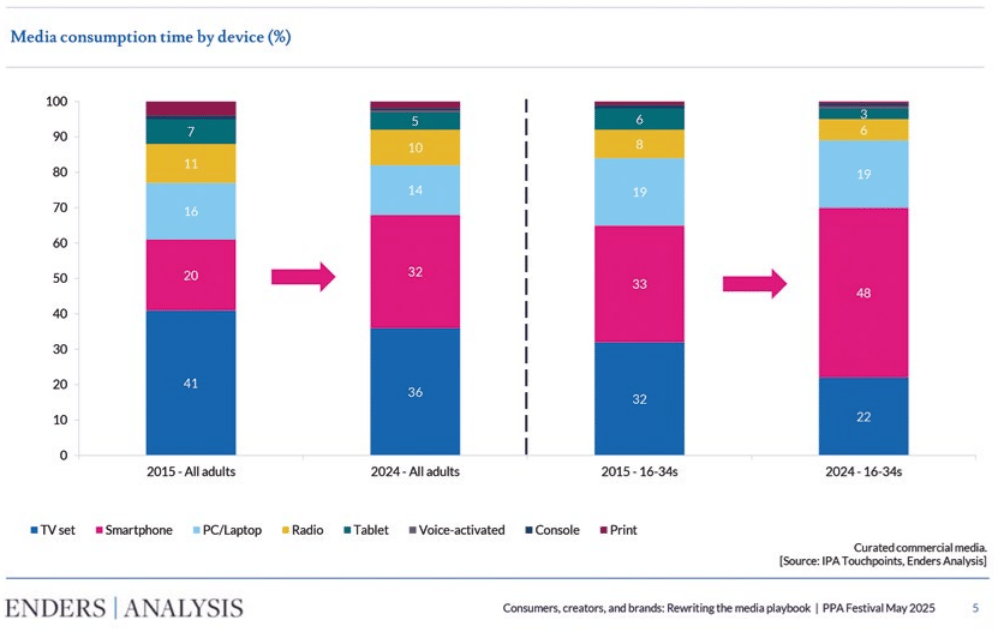
Time online tripled between 2010 and 2024, to reach 4 hours and 20 minutes a day. According to Enders’ Rewriting the Media Playbook, under 34s spend 48% of all of their media time on their smartphones. Even when they are spending time with TV, almost 70% of consumers under 34 look at their phones fairly or very often.
Discovery is also harder than ever. The space given over to magazines in real-world retail is contracting, and online visibility is facing a triple threat: from the deluge of creator content on platforms like TikTok; the active deprioritisation of publisher content on social networks like Facebook and Twitter(X); and zero-click search summaries that could decimate clickthroughs.
Consider: Subscriptions. Cultivating direct relationships through newsletters and online communities also allows direct communication with otherwise anonymous digital audiences. Podcasts allow you to speak to your listeners – and don’t forget you have your print subscribers’ addresses… direct mail is still a thing.
Getting readers to pay
Not only is it difficult to capture and keep the attention of potential readers, many of them have lost the habit of buying magazines – if they ever developed it.
Competing with the endless scroll of free content is possibly the print publishers’ biggest test. Crafting a clear value proposition for a print title that prospective purchasers may never have held in their hands is next. While regular print consumers may not be price sensitive, getting first-timers to pay upwards of £10 for a single copy or £40 plus for an annual subscription demands a focus on value that digital’s drive-by audiences rarely appreciate.
And while reader retention is crucial, it often takes second place to acquisition efforts, especially with new publications or relaunches. Capturing and keeping paying readers are separate skills.
Consider: Leaning into the tangibility of your magazine. Emphasise the things that make it unique and different from digital. Get your magazine out into the world; place it in adjacent retail outlets or take it to exhibitions and trade shows. Give people the chance to feel the quality.
Finding talent
Would you join an industry that you have been told is dying? There is a very real chance that the fallout from years of toxic ‘print is dead’ chatter will discourage future generations from seeing magazine publishing as a worthwhile career choice.
From reporters and journalists to page designers and printers, the magazine industry employs fewer people than ever. And, as older professionals retire or lose their jobs, there is a question of whether print publishing can retain the expertise needed to remain effective and profitable. A lot of talent is being lost, says Davy Drieghe, the former director of international print operations at The New York Times, who sees the loss as a ‘critical threat’ to the industry.
Add in the scarcity of well-paying jobs, especially outside of major metropolitan areas where the cost of living is prohibitively expensive, and magazine publishing potentially has a people problem: Fewer people willing to join the industry and a less diverse pool of people able to.
Consider: Engaging with university publishing programmes. Speak to students; the chances are they don’t know about the opportunities magazine publishing offers across print and digital. Often, they don’t have a negative view of magazine publishing – they have no view at all.
Combatting digital decay
Modern magazines need digital to survive and thrive, but the phony war that sets up the false binary of print versus digital still undermines commitment to the development of analogue formats.
Years of low-cost cut-and-paste content distribution online have addicted consumers to low-quality, often free, substitutes to print. Now that they have alternatives – from Netflix to ChatGPT – winning audiences back to pay for high-quality digital-information products and genuinely complementary premium print will require investment in both reader research and product development.
Outdated tech-stacks, especially content management systems, hamper efforts to differentiate content for consumers online and in print. Old-school one-size-fits-all technology solutions won’t work for publishers who are truly trying to meet the unique needs of their own audience.
Consider: Auditing your tech stack to support your efforts to maximise the ROI on every piece of content you create. Develop an audience-first approach to product development that emphasises the unique properties of each element in your publishing portfolio, print and digital.
This chapter is taken from our report, Inside the Print Revival. Download it here, or buy your own copy in print.