- The Publisher Newsletter
- Posts
- Informa Plc’s Alex Roth on why AI integration is like a trip to IKEA
Informa Plc’s Alex Roth on why AI integration is like a trip to IKEA
Informa is the biggest B2B events business in the world. Their AI strategy comes in three parts, focused on improving ways of working, product development, and content discovery.


Media Voices & Peter Houston
March 17, 2026
Welcome to the Publisher Newsletter by Media Voices: profiling the people and products powering publishing.
- ad -
How The Economist cultivates reader relationships with audience-led polls
The Economist has deepened their reader relationships by launching The Insider - a weekly newsletter and discussion show, which enables readers to participate via polls.
In a success story with Opinary by Affinity, they provide exclusive insights into their engagement strategy and the results achieved.

Informa Plc’s Alex Roth on why AI integration is like a trip to IKEA
Informa is the biggest B2B events business in the world. Their AI strategy comes in three parts, focused on improving ways of working, product development, and content discovery.
Alex Roth, Informa’s Strategy Director, is responsible for business planning, M&A, and overall strategy. He told senior media advisor Natasha Christie-Miller at November’s Definitive AI Forum that AI integration is like a trip to a certain Swedish furniture store.
“If you know that you need four kitchen chairs and you go in and all you do is get four kitchen chairs, it’s a very successful trip to IKEA,” he said. “If you go to IKEA and you wander, it’s a complete disaster.”
For Alex, publishers and event organisers must approach AI with a clear idea of what they want to achieve. Following this approach, in the middle of 2025 Informa took an honest look at how it was using AI in three key areas: ways of working; product development; and content discovery.
The business had programmes around each of these areas and had rated its performance using a traffic light system. “Our report card to ourselves was not very good, but in the last six months we’ve achieved a bit of lift,” he shared.
Process re-engineering
To improve ways of working, the company has rethought operations inside the business, incorporating AI into process re-engineering. Alex said: “One of the things that we did was we launched our own proprietary AI tool – Elysia – which is basically a white-label version of the Anthropic Claude product.”
Alex explained that one of the key benefits of developing a white-label version of Claude was that, because it is proprietary and working only with internal data, there were no concerns about confidentiality or of other publishers benefitting from Informa data.
Using Elysia as the foundation, Informa’s intention was to develop a range of AI agents across a a variety of use cases throughout the organisation. However, Alex said the team very quickly realised that this would become a limiting factor for innovation within Informa. “If you had a use case, it had to get in the queue and the team had to develop the agent.”
The solution to the bottleneck was an AI agent itself – the Elysia app-builder – that could build apps without calling on the AI team’s development resources. Ahead of its official launch, the app-builder agent had 800 apps in an internal app store.
“What’s happened is the venue of innovation in our business has shifted away from the AI team,” Alex pointed out, “and it’s moved straight into the hands of the business, whatever function they’re in, to create something that facilitates their ways of working.”
Alex gave the example of someone in the sales team looking for client information before a sales call. “They realise that is a process that they are continuously running,” he said. “They don’t need to go to the Elysia team to have them build an agent, all they have to do is use the app builder to build that routine for them.
“They can embed it into their workflow, and put it into the store so that other people can access it and use it for themselves.”
Product evolution
Alex acknowledged that one of the problems historically with the trade show business is that it hasn’t really changed much from its origins in the 13th century.
However, he believes that data provides an opportunity to evolve the trade show offering by facilitating matchmaking between buyers and sellers. “I think that we’ve come to this at precisely the time that AI has shown up on the scene,” he said.
As part of the One Informa programme – a strategic four-year initiative to integrate Informa’s B2B event businesses into a single, unified operating structure – the business has reviewed the product development roadmap for a large number of products. “We’re basically infusing AI into the product roadmaps in order to make sure that the customer is having a better experience and getting better ROI on their investment,” Alex said.
He highlighted how it can be difficult for exhibitors in the trade show environment to get all the information needed to make a sale: conversations with customers and prospects can deliver limited information or key people aren’t always in attendance. “We want to use the access to data that we have to enrich the level of insight that an exhibitor has about the leads that are collected during the show.”
Using apps, movement trackers and even facial recognition software that can interpret how people are reacting to products, visitor data can be enriched to form a more comprehensive view of trade show interactions.
“So when there’s an exchange of information… and you have a lead… Informa can provide you with insight about that lead by bringing to bear all of the data that it has. It allows the exhibitor… to mount a campaign that’s going to be much more purposeful and effective in making that sale.”
Alex noted that Informa is already selling this service, called Lead Insights, and has a goal of quadrupling sales in 2026.
“It’s not going from one to four, it’s going from a big number to a very big number,” he outlined. “Our ability to constantly enhance this product, and every year charge more and more for the product, is going to be a function of A) what data we can bring to the game, and B) our ability to cut through that data using AI.”
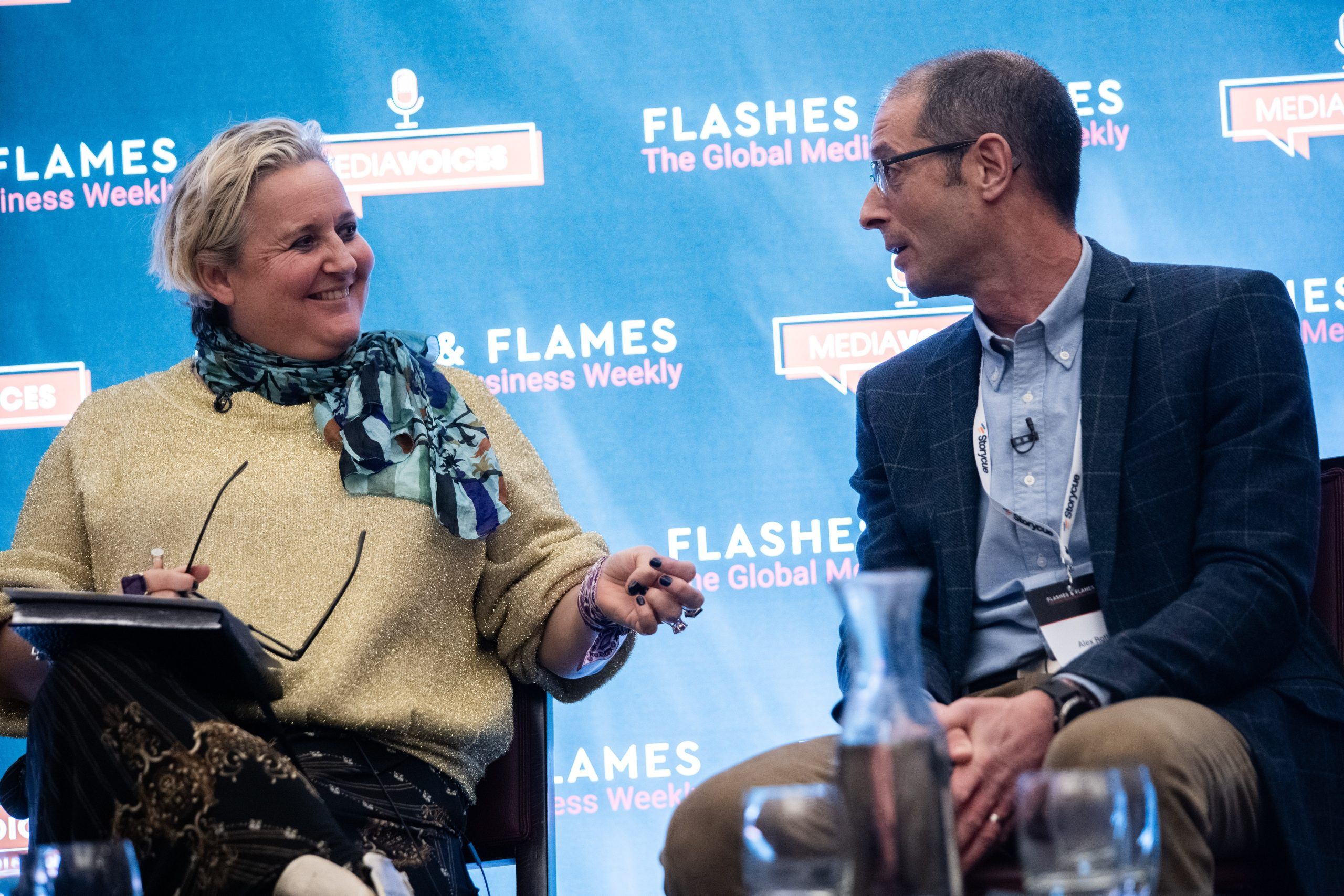
Alex Roth, Strategy Director, Informa Plc, talking to Natasha Christie-Miller at The Definitive AI Forum. Picture by Simon Crompton-Reid, Confex Media.
Improving discoverability
Content discovery, the third area in Informa’s three-part AI strategy, scored red in the company’s internal analysis. “We were quite concerned that AI search would move people away from our media sites, which is really important for fueling products like Lead Insights, and it would move people away from our websites, which are important for getting audiences to our show,” Alex said.
After investigating how crawlers work, Informa saw that the solution may lie in creating a shadow environment for crawlers, a carefully structured layer for crawlers to index that will direct people into Informa’s sites more effectively.
Worries that AI search would impact traffic to content published by Taylor and Francis, Informa’s academic publishing arm, have been eased by this approach. Alex explained that the number of people coming to Taylor and Francis content through AI search now rivals Google Scholar.
“They come in and they don’t want the synopsis. Remember, it’s academic content, I can only describe it as serious stuff. When they come in, they’re going into our articles.”
Alex also highlighted Informa’s approach to content licensing. “We’ve deliberately set up our licensing deals in a way that requires the LLMs to provide the source and citations. People are coming through and they’re going into the articles, they’re using the articles, and then our authors are getting the citations on whatever articles are being used for further knowledge and research.”
With a tight focus on use-case driven AI development in these three key areas, Informa is working to turn AI search from a threat into a smarter discovery channel, supercharge trade show value through AI enriched data, and empower staff with their own AI app builder and app store.
What the company is not doing is chasing every opportunity, simply because the number of potential use cases is unlimited. “It’s absolutely endless,” Alex said. “Go in with a view of what you want to do, make that investment, make it work, and then build from there.”
Listen to the full session in this week’s episode of The Publisher Podcast, available wherever you find podcasts.