- The Publisher Newsletter
- Posts
- How three newsrooms are using AI to transform their journalism
How three newsrooms are using AI to transform their journalism
Leaders at News UK, FT Specialist Europe and Bauer Media Group share how they are using AI tools to support journalistic talent, make the most of content, and unlock growth across other brands.


Media Voices & Esther Kezia Thorpe
February 03, 2026
Welcome to the Publisher Newsletter by Media Voices: profiling the people and products powering publishing.
Bookings are now open for our spring Publisher Masterclass series! If you’re wondering where to start with AI, how it can bring content to life, or how to measure ROI on AI projects, we’ve got a virtual class for you.

How three newsrooms are using AI to transform their journalism
Many newsrooms are grappling with the potential threats AI poses to their processes and business models. But with careful use, AI can also be transformative. Leaders at News UK, FT Specialist Europe and Bauer Media Group share how they are using AI tools to support journalistic talent, make the most of content, and unlock growth across other brands.
Tom Jackson, EVP and CTO at News UK, Carola York, Managing Director at FT Specialist Europe, and Stuart Forrest, Global Audience Director at Bauer Media Group joined us on a panel at our Definitive AI Forum, held in London at the end of 2025.
The discussion touched on a wide range of areas, from how AI is being used to help teams solve pain points across sales, subscriptions, marketing and editorial, to what success looks like for newsroom AI projects. You can listen to the full panel below, or by searching ‘The Publisher Podcast’ on your podcast app.
The strongest thread was how careful use of AI tools is transforming journalists’ work and its distribution across channels. Here are some of the key highlights.
Making the most of journalistic talent
News UK are emphatic that AI is not going to be used to replace human journalists. Instead, Tom shared that they approach AI as a way to make the most of the journalistic talent they have.
“With AI tools, we’re able – at scale – to build those individual brands, particularly on social platforms, which we weren’t able to do before,” he explained.
One example Tom highlighted was of Fraser Nelson, one of The Times’ top political journalists and columnists. Fraser has been experimenting with videos talking about the columns he’s writing. “We used AI to draft a script for one of those videos, and we used AI to chunk those videos up, and get them out there on places like Instagram,” Tom outlined.
“One of those videos in particular went viral. Typically, we’d see low hundreds of thousands on videos, but on Instagram, suddenly this one went viral and had millions of views… and that actually reached a lot of Gen Z that Fraser had never reached before.”
Tom said that adapting to being ‘personalities’ and having to podcast and present as well as write suited some talent more than others. But he noted that demands on journalists are increasing, and AI can help.
“We’re expecting them to speak on Times Radio over here, and then do a podcast over here, then do a video and a social post,” he highlighted. “The benefit of AI is that it makes that sustainable, because it can take some of the grunt work out of what they were previously doing.”
Another example Tom highlighted where AI is helping News UK journalists is in collecting material. They are using AI-powered tools like Google’s NotebookLM to put source materials, from large legal documents to interviews, which they can then interrogate directly to hone in on specific quotes or information.
FT Specialist’s editorial team have created an AI hack ‘library’ which shares prompts and tips for everything from creating SEO-optimised headlines or checking a freelancer has followed a brief. Crucially, Carola pointed out that it’s been created by the teams themselves, rather than coming from higher up, which has helped enthusiasm and adoption.
“Traditionally, tech has been something that the tech department has done,” she explained. “Now, these tools are enabling our editorial teams to look at the pain points they have, or things they can do to speed stuff up, or inspiring them.”
Both News UK and FT Specialist are using AI-powered transcription tools to help journalists. Carola and Tom said this had a measurable impact on their writers’ productivity. “We’ve had issues with people saying they were overloaded, and [AI transcription] has helped us balance that and save time,” Carola explained.
Tom agreed, noting that they have seen a directly measurable increase in output by cutting the time it takes to listen back and transcribe interviews. “The first bit of the process, we’ve been able to use AI to take out, so now [journalists] can just think about writing the article,” he said, pointing out that feature writers can in some cases now do four in-depth articles a week rather than two.
Making the most of content
Another News UK brand, TalkSport, has been using AI to better use its hundreds of thousands of words’ worth of daily content. “If you look at 24 hours of coverage, [we produce] the equivalent of the New Testament every day,” Tom illustrated. “No one can listen to all of that. But we know that many of our audiences are superfans of the top five big clubs in the Premier League.”
His team now uses AI tools to go through the content, and find all the references to Manchester United, for example. They then create a visualised club-specific podcast around that every day. “It’s not like we’re using AI to create that content,” Tom emphasised. “It’s enabling us to do more with that content that already exists that we weren’t able to do before.”
Tom shared that News UK is making a big bet on audio and video this year as a protective measure as well as using the tools to speed up production. “Pretty much all audio is now visualised in one way, shape or form, and that’s harder for AI to replicate,” he explained, referencing their journalist’s depth of analysis and human connections.
At Bauer, Stuart explained that his focus when it comes to content is on what AI can do pre- and post-publishing. With the help of a new AI-powered publishing platform, journalists and editors have access to better and more automated content planning processes. “We’ve got some really nice agentic processes, semi-autonomous… delivering effectively editorial intelligence to a journalist that really helps them understand the shape and size of consumer demand,” he said.
AI also helps the publisher once content has gone live. Although freshness has a strong correlation with performance when it comes to SEO, there are also benefits to updating older content. “We have in trial at the moment, a really smart tool that is effectively a decision tree,” Stuart explained, saying that it takes into account performance data, consumer demand data, revenue data and ranking data across tens of thousands of URLs. “[The tool] then tells you as an editor where to spend your time, and where not to spend your time.”
Stuart said that it’s important to accept that for some search queries, consumers don’t care whether the answer is synthesised by AI or not. Instead, publishers need to look at what quality brands can do differently.
“Traffic from telling people how long it takes to make a poached egg has probably gone,” he outlined, using an example of one of Bauer’s German cooking websites. “But the inspiration which comes from the content collaboration with Raymond Blanc on how to make the greatest poached egg on avocado toast that you’ll ever make, that provokes a different response… it can’t be synthesised as easily, and I’m not sure as a consumer, that I would accept [an AI overview].”
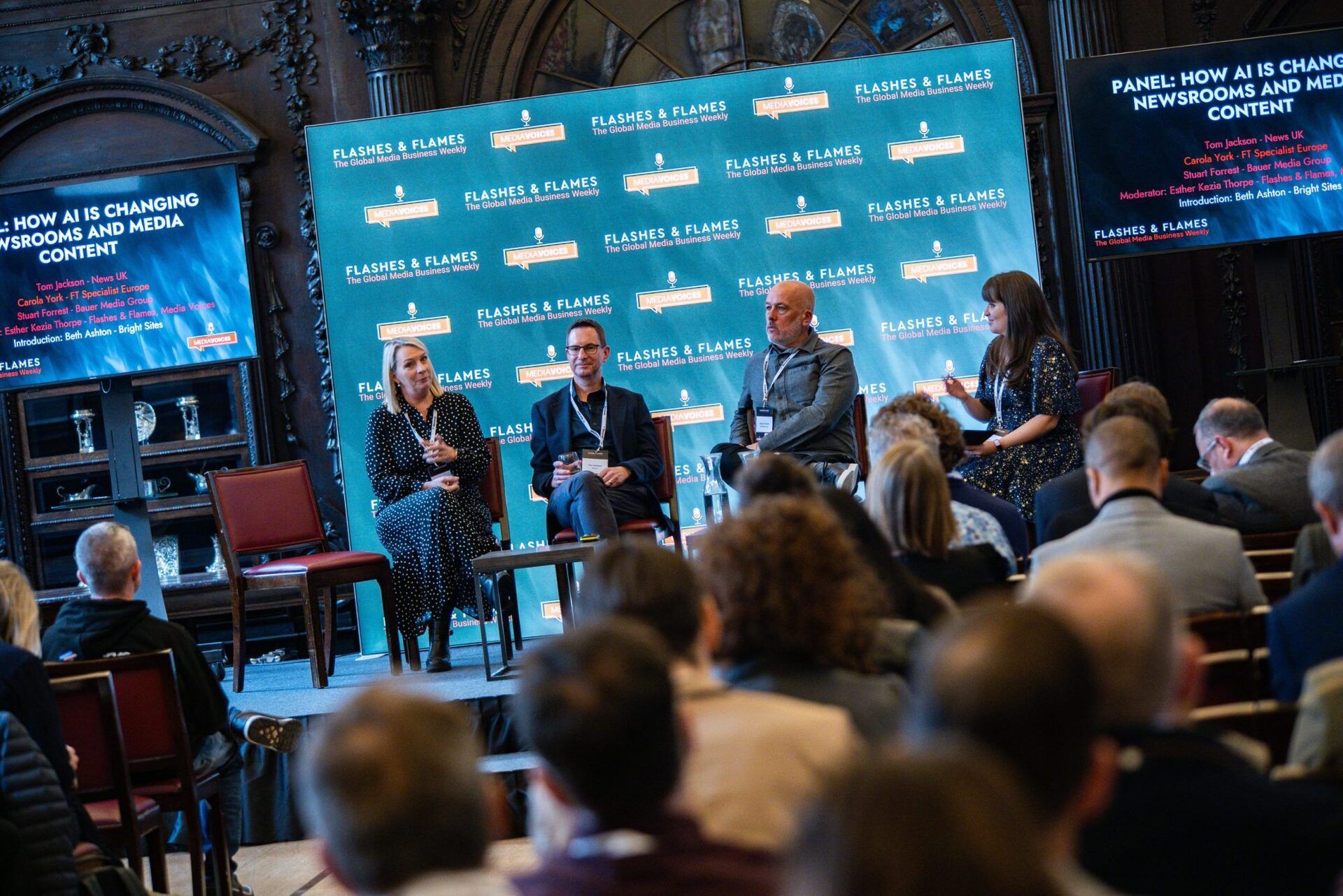
Carola York, Managing Director at FT Specialist Europe, Tom Jackson, EVP and CTO at News UK, Stuart Forrest, Global Audience Director at Bauer Media Group, and Esther Kezia Thorpe, Editorial & Events Director at Flashes & Flames / MediaVoices at The Definitive AI Forum. Picture by Simon Crompton-Reid, Confex Media.
One of the major benefits of these AI tools and processes at Bauer has been for their smaller brands. Stuart explained that even for titles with a good business model, their size doesn’t always justify dedicated human support.
“We have a fantastic brand called Angling Times,” he shared. “It’s not huge, so I can’t support it with an SEO resource. But they now have access to a lot of the processes that some of our bigger brands like Grazia or Empire or Motorcycle News would get.”
“What’s going to be very interesting is, how much growth does that unlock? It might not feel very big compared to Grazia, but actually if you’re doing that across a number of fronts at a much lower cost, it starts to look really, really interesting.”
Despite these many early benefits, all three agreed that they were proceeding carefully with AI for now. “There’s always a human all the way through everything that we do, and it’s controlled,” concluded Carola. “We are embracing it, but embracing it cautiously, and making sure that everything AI is being used for is tested, is secure, is safe.”
Listen to the full session in this week’s episode of The Publisher Podcast, available wherever you find podcasts.