- The Publisher Newsletter
- Posts
- How AI could transform events and exhibitions
How AI could transform events and exhibitions
Leaders at Terrapinn, Nineteen Group, Emap and RX Global share what opportunities they see in AI for events businesses, and where they’re experimenting.


Media Voices & Esther Kezia Thorpe
March 10, 2026
Welcome to the Publisher Newsletter by Media Voices: profiling the people and products powering publishing.
Monetising B2B is returning to the historic Stationers’ Hall on Wednesday 13th May. It's a one-day deepdive into how 28 B2B media, information and events companies innovate, grow and make money. Early Bird rates end on Friday so get booking now for the best value tickets.

How AI could transform events and exhibitions
We’re some way off sending our robot counterparts to events for us, which means as a sector, events and exhibitions are facing less of an existential threat from AI as some other parts of the media industry. Leaders at Terrapinn, Nineteen Group, Emap and RX Global share what opportunities they see in AI for events businesses, and where they’re experimenting.
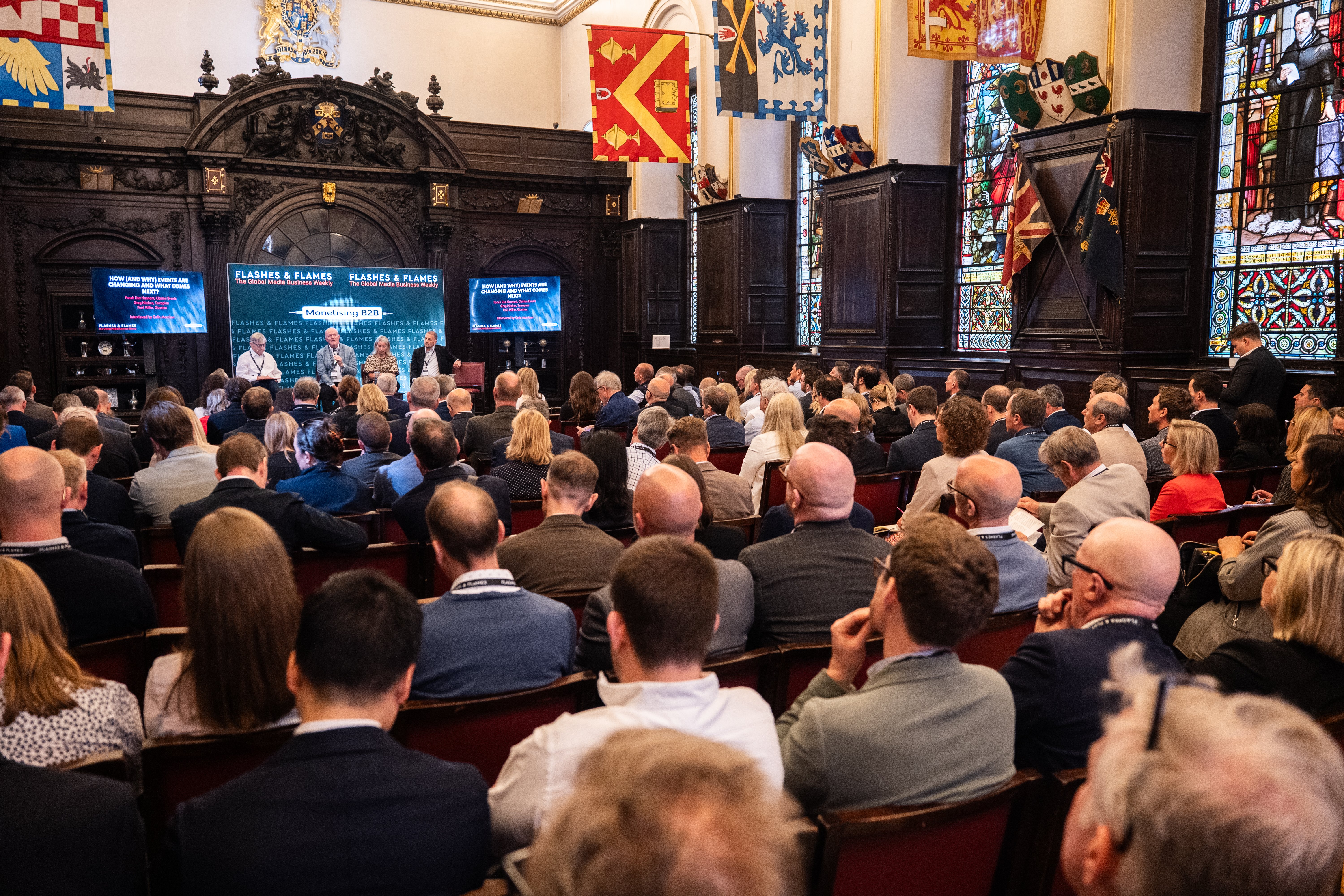
At The Definitive AI Forum, held in London by Flashes & Flames and MediaVoices, there was a panel exploring the extent to which AI is a ‘golden opportunity’ for exhibitions and events organisers.
On the panel was Greg Hitchen, CEO of Terrapinn, Alison Jackson, Group MD of Nineteen Group, Robin Booth, Managing Director of Emap, and Robin Tapp, CIO of RX Global, moderated by Flashes & Flames’ Colin Morrison.
Unlike some of the other media organisations who shared their stories on the day, events and exhibitions companies are still in a much more experimental phase of AI – or as Nineteen Group’s Alison Jackson said, in their ‘MySpace era’. There is a great deal of optimism about its potential, but few concrete examples of transformation so far.
This may be partly due to the natural resilience of events businesses. “Whilst AI is destroying and disrupting many media, it cannot really destroy face-to-face,” Terrapinn’s Hitchen emphasised. “It can augment it, it can make it better, but I do not believe it will destroy it, there is no existential crisis.”
Nineteen Group, whose business is almost 90% trade shows, also sees more opportunity than threat from AI. “Trade shows have been around since 1241, they’re not going anywhere,” Jackson noted. “They bounced back from the pandemic. But they are very, very laborious processes, and there’s a lot that goes into it.”
Booth can see plenty of ways AI can help at Emap, where the majority of the business is made up of conferences and awards; between 80 and 90 every year. “What we’re trying to think about more is not what can the AI do, but what event problems have we got that this might help with?” he explained.
He identified two priority ‘problem’ areas which AI can help with. The first is in encouraging attendees to come to events as they are often time-poor; something promised productivity gains from AI may well unlock.
Then on the sponsor side, there’s an opportunity to help with communication. “Sponsors have got much more demanding around ROI,” Booth pointed out. “I don’t think we’ve very good at explaining to them what they’re going to get, and then afterwards what they actually got, and the value to them. AI has a massive role to play there.”
Buyer and seller matching
The most tangible way AI could transform events and exhibitions businesses in the short term is improved buyer and seller relationships. “If we can find a way to match buyers with sellers in a seamless way, that uses lots of metadata…we could apply that to our brands and our data, and we could potentially go into other media businesses,” Terrapinn’s Hitchen shared.
RX is already using technology on the majority of its 400+ global events, and are starting to bring AI into that process. Tapp explained that they’ve been using very simple QR code scanning technology on exhibitor stands to gather information about who’s meeting who.
“We’re now starting to augment that with feedback on [whether] that was a good meeting, why or why not,” he outlined. They are then using that information to create a real-time version of recommendations for attendees.
There is also value in this information for other events and their industry verticals, as Tapp explained: “We might have a show in construction in London, in Paris, in New York. By the time we get to New York, we know what’s hot and what’s not this year in the industry, we know what’s going to work and what isn’t, and we can start to create insight products for our exhibitors to [make] New York more successful; this is the sort of stuff that’s working really well at the moment in London and Paris.”
As Hitchen and Booth alluded to, augmentation of current events is a priority for RX, rather than dramatic transformation. Tapp highlighted that any data or information that can be used as insights for exhibitors partway through an event rather than later on will improve rebooking and longer-term relationships.
“If [exhibitors] have had a bad first day and you come along with some advice, and they have a fantastic second day, my goodness that drives up the satisfaction in the event,” he said.
Nineteen Group’s Jackson sees the buyer and seller matching as a difficult process that AI can’t necessarily help by itself. Instead, she sees potential in streamlining behind the scenes so the business can better focus on nurturing those relationships.
“We’ve all been to trade shows where… you open the doors, no one comes in,” she illustrated. “For me, [AI is] a massive opportunity to take away all the processes, all the laborious work, and focus on delighting the customer and putting them in front of the right person.”
Data and content
Jackson’s goal for Nineteen Group this year is to move from experimenting with AI to being more systematic in its implementation. They are exploring effective use of AI-powered sales, events and meeting apps, as well as better data analysis. “You’ve got 10,000 people in a hall, and they’re looking at 300 different sets of products,” she pointed out. “What you can do with that data is off the charts.”
Data is RX’s ‘secret sauce’, and something Tapp will be protecting rather than selling or licensing. “For anybody in the world of fast-paced AI, know what your differentiator is, and focus on protecting it like mad,” he explained. “So we will not be selling that data. We might sell insights arising from that data, but our key is to have better knowledge, better data from which to drive insight than others.”
Interestingly when compared to media businesses where content is central, there were fewer qualms about using AI in content on the panel. Jackson explained that at Nineteen Group, where around 10% of the business is content, their editorial teams have been “producing the content faster and thinking about how we might monetise it outside of the trade show experience” with AI.
Emap’s Booth still sees a vital role for human writers in their own business going forward, but with caveats. They have started feeding audio from their events into AI-powered transcription tools, which give an almost ‘live’ record of what’s been said; something we also did at the Definitive AI Forum.
“We use Otter AI to record the session live, we feed that into ChatGPT, and it pops up with the takeaways. Everybody wants takeaways from an event. What do I need to remember? What did I need to do?” he shared.
But this doesn’t necessarily need to be done by humans – although from our own experience, we’d recommend stringent editorial oversight. “If we keep on providing event content [by humans] about what has happened, we are never going to be as good as the LLMs – they’ll beat us to it,” Booth pointed out. “Content is going to need to be much more forward-looking. It’s going to need to be about conjecture, imagination and inspiration.”

Colin Morrison, Flashes & Flames, talking to Greg Hitchen, CEO, Terrapinn, Robin Tapp, CIO, RX, Robin Booth, Managing Director, Emap, and Alison Jackson, Group MD, Nineteen Group at The Definitive AI Forum. Picture by Simon Crompton-Reid, Confex Media.
Improved services
The third area the panellists noted was ripe for AI opportunities was service improvement. Jackson said that the trade show process itself is very simple: hire a hall and sell. “If you can use AI to help the sales people change their script, listen to their voice…you will sell more,” she explained, demonstrating where AI is beginning to make a difference to Nineteen Group.
Emap are beginning to see tangible improvements by using AI in their awards processes. Despite being a high-margin, successful business, there’s a lot of room for a better experience.
“I don’t think we have ever provided a good enough service [on awards],” Booth admitted. “We expect entrants to take hours to fill out a very complicated entry form, and then we say, ‘Thanks for doing that. Bad luck, you weren’t shortlisted. See you next year.’ Would you come back next year?”
He shared an example of their Local Government Chronicle Awards, which attract over 2,000 entries each year, with an average on-the-night attendance of 1,400 people. There simply wasn’t capacity to gather and pass on feedback to those who weren’t shortlisted.
“We will now provide judges’ feedback on every single entry, whether you were shortlisted or not,” said Booth, thanks to AI tools on their awards software which helps collect and send over comments. He hopes that this will translate through to better entries in the future, and more satisfaction in the process all round.
A wake-up call
The panel warned about complacency in harnessing AI, despite the relative resilience of events and exhibitions.
RX’s Tapp said that it was vital not to approach AI like it’s standing still. “In the next 2, 3, 5 years, it won’t be the same thing as it is now, it will be fantastically more capable,” he said, noting its current limitations. “The key thing for us now is to gather the data, and get that machine working as effectively as we can.”
Emap’s Booth thinks AI is going to be a big wake-up call for the industry. “I think we’re a bit complacent in the events space; we’ve trotted out the same stuff on conferences for years,” he explained. “The experience has got to get better, the content has got to get better, the analytics have got to get better.
“And I think AI has a very big role to play in all three of those things.”
Listen to the session here, or search ‘The Publisher Podcast’ wherever you find podcasts.