- The Publisher Newsletter
- Posts
- Hearst UK’s Toby Wiseman on aligning staff attitudes to AI
Hearst UK’s Toby Wiseman on aligning staff attitudes to AI
Toby Wiseman, MD for content at Hearst UK, sees AI being used to organise archives, power services and personalise distribution, supporting Hearst’s brands to reconnect with their communities.


Media Voices & Peter Houston
January 27, 2026
Welcome to the Publisher Newsletter by Media Voices: profiling the people and products powering publishing.
Hearst UK’s Toby Wiseman on aligning staff attitudes to AI
At November’s Definitive AI Forum for Media, Information & Events, Toby Wiseman, MD for content at Hearst UK, said he wants staff to see AI as a powerful but invisible assistant. He sees it being used to organise archives, power services and personalise distribution, supporting Hearst’s brands to reconnect with their communities.
Toby said that if you’d asked five different people at the magazine publisher what AI meant to them a year ago you would have got five different answers. “The last year has really been about trying to galvanise how we as a company view AI, where it fits in with our strategy, and trying to get everyone on to the same page,” he said, talking to Flashes and Flames’ Colin Morrison on stage.
The beginning of that process was an AI amnesty that allowed staff to come forward and say what they had been using or what they hadn’t been using without ‘fear of retribution’. This was accompanied by a series of drop-in clinics where staff could ask questions and air concerns. “[It was] basically just to break the ice and make people feel comfortable talking about these things,” Toby explained.
Regular training sessions on how to use AI tools – including sessions on building custom GPTs – have followed, along with an AI policy and a longer-term project that looks at where AI sits in Hearst’s five-year strategy.
“Crucially, we’ve been doing another piece of work, demonstrating our values, setting out our guidelines for the next five years. AI is very much part of the invisible bedrock and infrastructure of that, but absolutely nothing to do with what our brands mean to people.”
AI’s value
For Toby, AI has no place in the origination of content at Hearst. “If anyone can make anything… the more it puts downward pressure on the value [of content],” he said. “It forces us to ask what makes our editorial output distinct?”
Part of the drive for differentiation lies in the presentation of content and Toby sees AI enabling innovation in content distribution, particularly around personalisation. “If you think about magazines, they’re fairly monolithic creations. We have the ability to break down the building blocks of the content we produce to cater for individual interests.”
This aligns perfectly with Hearst’s ambitions to connect its content with its audiences and Toby spotlighted a company-wide archive project to illustrate the value AI can add. He explained that Hearst UK has huge content archives, covering 17 magazine brands and going back decades. “That’s just sitting there,” he said.
“We tap into it as humans to recycle and repurpose, but you can actually use AI as a kind of librarian, as a curator that can take the building blocks of those things and create new products… to be able to tap into new trends or developments and be more reactive to the sort of things that are going on in the world.”
He noted that the dominant conversation around the use of AI centres on the creation of operational efficiencies. “Of course people talk about AI in terms of efficiencies,” he said, “and we’ll always be interested in efficiencies. I’m more interested in value creation, rather than cost cutting.”
Anti-magazine?
Asked if AI could be seen as being anti-magazine, fragmenting the traditional edition-based format, Toby argued that it is the opposite, instead seeing search – the ‘Googleization’ of content – as the opposite of magazine-style curation. “The very nature of search is that people are looking for answers. We are, as humans, as creatives, deciding what we think the members of our club would want to consume.”
Part of Hearst UK’s five-year strategy project was a short booklet titled ‘This is not a magazine’. “The idea that a magazine is this monolithic entity is perhaps something we’re going to leave behind, “ he explained.
Instead, he is focussed on the ‘warehouse’ origins of the word. “I think that, if we can work out ways that we can avoid that kind of Google mediation by using AI to connect directly to customers again, we restore that link between the content and the community, which is what magazines are all about in the first place.”
This approach to AI supports Hearst UK’s central ethos: to connect content with communities. “We want to become the world’s biggest membership company,” said Toby. “That’s at the heart of everything we do, and I do think that we can use AI to re-galvanise the connections which I think have been lost as the relationship between content and people has been mediated by the internet.”
Publishers have been struggling against disintermediation by tech platforms for decades, but Toby said that AI could be a way to refresh community connections. “We have never been more interconnected via platforms, and yet we’ve never been so dislocated,” he said, “I think that we’ve lost that integral club mentality that you have with an old-fashioned magazine brand. So we want to restore those connections.”
He saw the starting point for that reconnection meeting people where they are, intellectually, emotionally and culturally, but also digitally. “It’s about how we repurpose, recreate, and become a truly multiplatform publisher across multiple platforms,” he said.
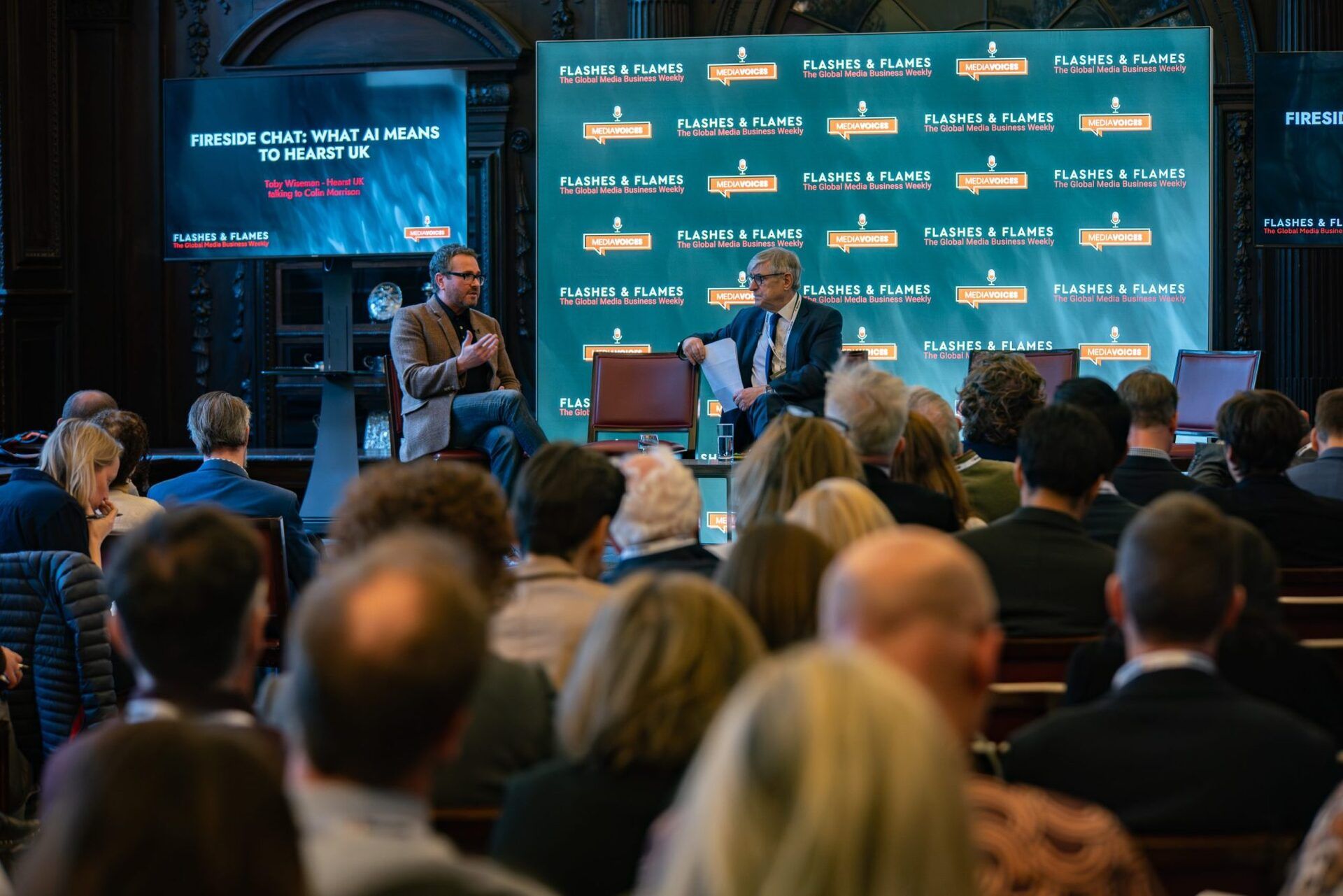
Toby Wiseman, Managing Director, Content, Hearst UK, talking to Colin Morrison at The Definitive AI Forum. Picture by Simon Crompton-Reid, Confex Media.
Openness and transparency
Coming back to how he wants to see AI adopted at Hearst, he said he wants ‘openness and transparency’. “We’ve been trying to put that into the culture at Hearst, starting with that amnesty.”
Toby applauded The New York Time’s approach to AI adoption, citing an email they sent to newsroom staff at the end of 2024. “The gist was, we may be suing OpenAI, but that doesn’t mean we don’t want you to be all over it. These are the tools that you can use. These are the ways in which we want you to use them, but absolutely never, ever at the expense of human oversight.”
Acknowledging the reality that most media organisations have smaller staffs than they once did, Toby said the focus of AI should be on creating the ‘keenest’ editorial system around.
With access to an enterprise version of ChatGPT, Hearst UK staff are encouraged to build their own GPTs to assist with routine tasks like optimising headlines. “It’s being able to use AI to replace the gophers in the room… but absolutely never, ever at the point of creation,” Toby explained. “Any publisher hoping to cut corners, rather than just cut costs, by using AI to create the content instead of humans, I think will face a reckoning.”
Listen to the full session in this week’s episode of The Publisher Podcast, available wherever you find podcasts.