- The Publisher Newsletter
- Posts
- The Independent’s CEO Christian Broughton on using AI to do more and be more human
The Independent’s CEO Christian Broughton on using AI to do more and be more human
Digital-only newsbrand The Independent is using AI to do more with a relatively small team, freeing up reporters to extend its mission as a dogma-free platform for trusted information, and drive talent-led audience engagement.


Media Voices & Peter Houston
January 13, 2026
Welcome to the Publisher Newsletter by Media Voices: profiling the people and products powering publishing.
The Independent’s CEO Christian Broughton on using AI to do more and be more human
Digital-only newsbrand The Independent is using AI to do more with a relatively small team, freeing up reporters to extend its mission as a dogma-free platform for trusted information, and drive talent-led audience engagement. CEO Christian Broughton outlines what AI means to the publisher.
The Independent is no stranger to change, boldly leaving its 30-year print history behind to go digital-only in the spring of 2016. Now, the news brand publishes internationally in six languages and has seen growth in revenue and profitability for the last eight years of its digital-only decade.
At November’s Definitive AI Forum for Media, Information & Events, Independent News and Media CEO Christian Broughton spoke with Flashes & Flames’ Colin Morrison about what AI means to the Independent. He talked about The Independent’s enthusiastic embrace of AI, using the tech to support its product development mission and amplify human value.
Enthusiastically AI
AI matters hugely to The Independent, according to CEO Christian Broughton. His newsroom has embraced the technology enthusiastically, using it to do ‘a huge amount more’ than it was previously capable of doing.
Speaking about the news brand’s switch to digital only he said: “We prospered back then by embracing the future and running straight toward the opportunity, not getting paralysed by the fear.” He said that period was a time of real change, but that the disruption accompanying the introduction of AI is even more profound.
“I think the changes happening now are much more sweeping. They run deeper. There’s so much coverage in our industry about the negative things happening, and sure, they will impact us. They already are. But it’s down to us to create the opportunity, the upside, and the potential for the future. So we’re very much approaching AI with that spirit.”
Hacking negativity
Like everyone else in publishing management, Christian said he had received a lot of pitches from software vendors that said ‘use this AI in your newsroom, it will change everything you do’. In a staff hack day organised alongside Google, feedback suggested otherwise
“I thought we’d use it, they’d tell me what they loved, and I’d say okay, fine, you can have that,” he explained. “Instead, we just saw that lots of the tools didn’t really work, the solutions being offered didn’t really exist, our journalists weren’t comfortable with them and they didn’t think the readers wanted some of the things being pitched.”
Christian said he apologised to Google’s Gemini team for the negative feedback but they said, ‘No, that was great, we rarely get that kind of unfiltered feedback’. “They have since supported The Independent to build tools for humans to use,” he said. “We now own the agents. We own the tools” said Christian. “It works with a variety of different LLMs, but we’re still using Gemini at the moment.”
The Bulletin ‘sandbox’ initiative
The key initiative to come out of that initial hack day was Bulletin, an experimental AI-powered news brand that Christian described as a sandbox for future AI developments at The Independent. “It has allowed us, within the sandbox of Bulletin, to get some tools right that we’re now rolling out across everything.”
Launched in April last year, the AI-powered sub-brand now gets about 8 million users a month between bulletin.news and the Bulletin app. “We give you a homepage of what we think are the top stories of the day, but when you first register for the app, it asks what you want to receive more of. It learns more about you and gives you a highly personalised feed.”
Describing the Bulletin workflow, Christian said The Independent’s news editors use AI tools to generate bullet-point summaries. Crucially, these are checked and signed off by humans.
“We wanted to create a way that you can get briefed without setting aside three hours of your day,” He explained. “We started with the same news editors who were putting up the journalism for The Independent. They would then use these tools to come up with a very tight summary, but human-checked right there in the moment by the same team that created the longer article.”
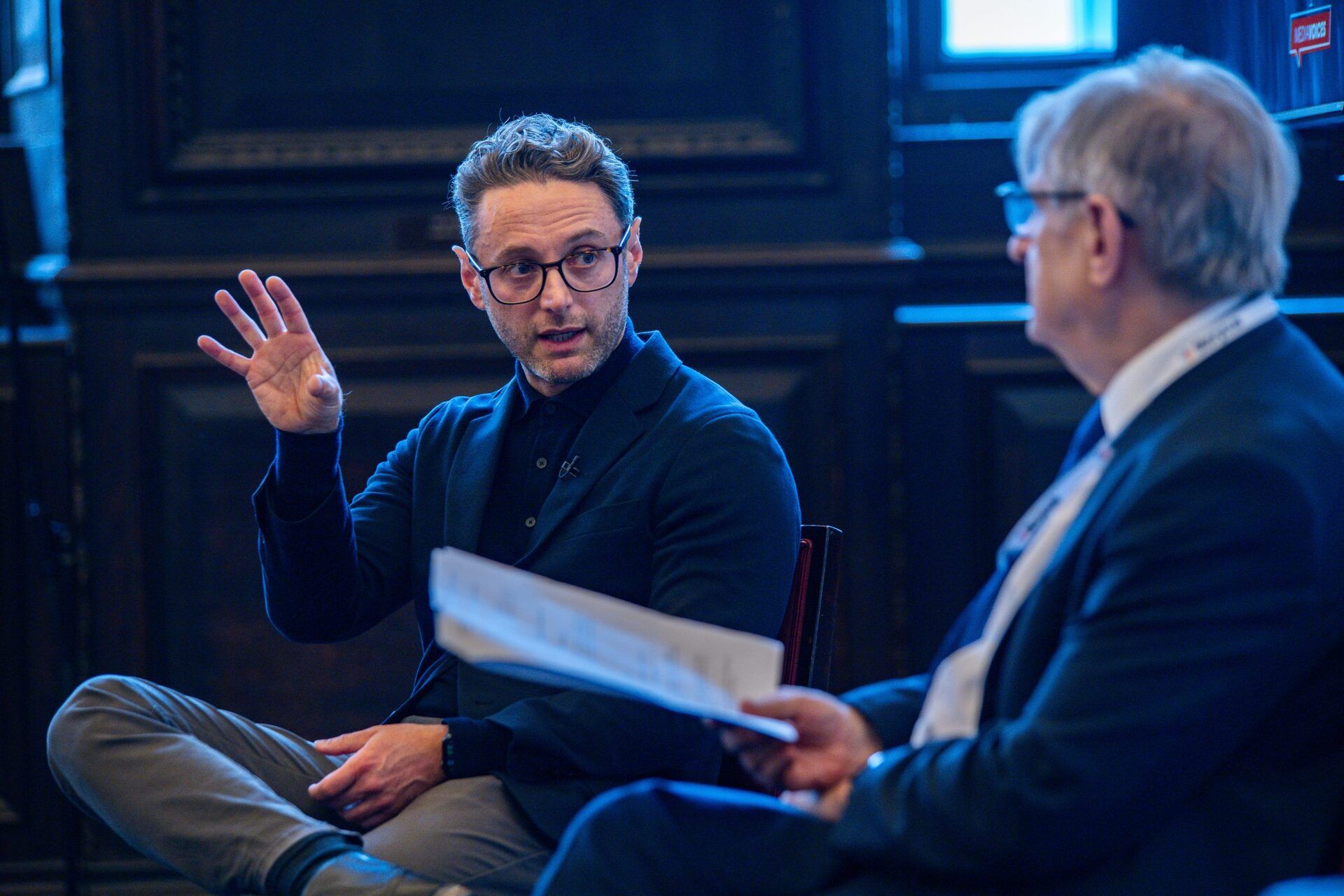
Christian Broughton, CEO, Independent News & Media, talking to Colin Morrison at The Definitive AI Forum. Picture by Simon Crompton-Reid, Confex Media.
Relationships vs referrals
Under the tag line ‘news for seriously busy people’, Bulletin readers can quickly skim bullet-point summaries, but also click through to The Independent’s website to get the full story. Christian said the referral units on Bulletin summaries are delivering the highest-engagement on any ‘read-more’ box the Independent has used previously.
However, he isn’t overly concerned about internal referral traffic, dismissing concerns about losing revenue by diverting users away from website advertising and focussing instead on reader relationships. “Wherever you’re building deep engagement – whether it’s audio, newsletters, podcasts, video series, documentary, written words – as long as you’ve got great differentiation and user engagement, then there’s a business model to support that.”
Talent-led media
For Christian, audience engagement is as much about people as it is about technology and from audio and video podcasts, to social video and newsletters, personalities are key. “It’s the kind of engagement that wraps itself around you. It’s always more emphatic when it’s led by a person, a talent, a creator, a journalist, someone who puts a face on it.”
Looking to an AI-assisted future, he believes human interaction is going to be more important than ever. “I think it’s about people, not publishers. The brand still means a huge amount, but it’s the people that really build that engagement.
“We’ve always been lucky enough to have charismatic journalists through the history of The Independent. I think it will be like that, but more so in the future – high-touch, highly personal.”
AI efficiency
However, achieving that level of engagement requires a real time investment. Christian said: “We’ve got to be out there doing more reporting, more interaction with audiences on the platforms. And in order to do that, we need to be super-efficient.”
That is clearly where AI can be a benefit to journalists and to illustrate the point, Christian recounted a conversation with one of the founders of Axios, who said its stripped-back content formats were a huge draw for new staff.
“One of the founders of Axios once said to me that their best recruiting tactic in the early days was: when you’ve got three facts and your editor wants 1,200 words, you’ll never have to do that here. The more time people spend getting new facts, and the less time doing the mechanical building of a news article, the better, as long as it can be signed off and fully responsible.”
“We’re a small business compared with some newsrooms. We’ve got 220 journalists globally,” he explained. “We can’t do everything – except we can now do a huge amount more because we’re efficient with AI.”
Listen to the full session in this week’s episode of The Publisher Podcast, available wherever you find podcasts.