- The Publisher Newsletter
- Posts
- AI and the future of trusted media: walking the tightrope between increased efficiency and editorial integrity
AI and the future of trusted media: walking the tightrope between increased efficiency and editorial integrity
At the heart of publishing’s AI conundrum lies the tension between maintaining public trust and the opportunity to exploit operational efficiencies crucial to commercial sustainability. Here’s how PA Media Group, Newsquest, Reach and FT Strategies are walking the tightrope.


Media Voices & Peter Houston
January 06, 2026
Happy New Year, and welcome back to the Publisher Newsletter, by Media Voices: profiling the people and products powering publishing.
AI and the future of trusted media: walking the tightrope between increased efficiency and editorial integrity
At the heart of publishing’s AI conundrum lies the tension between maintaining public trust and the opportunity to exploit operational efficiencies crucial to commercial sustainability. Here’s how PA Media Group, Newsquest, Reach and FT Strategies are walking the tightrope.
At November’s Definitive AI Forum for Media, Information & Events, we gathered together a panel of news industry heavyweights to talk through the issues associated with AI and the future of trusted media.
Moderated by Seedelta CEO Chris Duncan, the panel featured Emily Shelley, CEO of PA Media Group; Henry Faure Walker, CEO of Newsquest; Piers North, CEO of Reach plc, and Joanna Levesque, Managing Director at FT Strategies.
Trust is a non-negotiable
The commercial realities of modern-day publishing mean that every opportunity to increase operational efficiency has to be considered. However, in an online world increasingly dominated by AI slop, maintaining reader trust is table stakes for premium publishers.
For PA Media Group CEO Emily Shelley there is no question of putting AI efficiencies ahead of established editorial practices. “We come down heavily on the side of editorial integrity,” she emphasised. The newswire does use AI behind the scenes – in finance, tech management and production – but not in its reporting.
“AI can’t doorstep politicians, it can’t sit through court cases, it can’t listen to boring council meetings,” she explained. “We’ve looked at a number of tools and run a number of experiments; they’re just not accurate enough for us at the moment.”
Newsquest CEO Henry Faure Walker agreed that integrity and trust in the news brand is critical. However, they have a different approach to AI in reporting. “If we’re not efficient in our newsrooms and if we don’t lean into AI, then we’re not going to cover our community properly, and we’re going to lose integrity that way,” he pointed out.
The drive for comprehensive community coverage has led Newsquest to adopt AI tools ‘quite aggressively’, with Henry describing AI as positive for ‘hard-pressed’ local newsrooms. He explained how 35 AI-trained Newsquest journalists use a copy-drafting tool to take content from trusted information sources and draft articles using their own prompts.
With the support of this type of AI tool, Newsquest has increased the number of local stories it covered in the previous 12 months by 10%. “We now do 50,000 local stories a month and that is the bedrock to doing higher impact journalism.”
Piers North, CEO at Reach, drew a direct line between PA’s non-negotiable approach to maintaining editorial integrity and Newsquest’s drive for efficiency. Reach is using AI to bolster its video output, where Piers says it is a challenger.
“We need to have subtitling, editing, all of these heavy processes, and that can be done by AI. We might have found it hard to move into a more aggressive phase if I’d needed to hire 200 expensive video editors,” he said.
But he said it is important to look after what defines information as ‘real’. “You have to find that balance between the two, and that is a tightrope to walk,” he said. “To push the envelope on efficiency and speed, but making sure that we don’t lose the very point of our being.”
The human in the loop
For everyone on the panel, what defines information as ‘real’ was closely related to human involvement.
Of the 1,000-plus publishers FT Strategies has worked with, 100 have AI-related initiatives, according to Managing Director Joanna Levesque. These range from the automation of earthquake alerts to content repurposing in multiple languages.
“[What] we see across all of our initiatives is the opportunity to automate, the opportunity to scale, the opportunity to try new formats,” she said. “But the human in the loop and the transparency of where you’ve used AI, I think, is the [biggest] commonality.”
Instead of allowing AI to write straight to the page, publishers should be focussed on internal processes, described by Chris Duncan as somewhere between journalistic discovery and distribution.
Deploying AI to automate repetitive processes increases efficiency, but also allows publishers to double down on the work that supports greater public trust.
Henry said AI has enabled Newsquest to free up journalists to do more higher impact journalism, getting out and about and doing face-to-face interviews or spending more time on investigations. “The journalists can breathe again and actually go back – certainly in a local news context – to what you might call true journalism, or higher-impact journalism.”
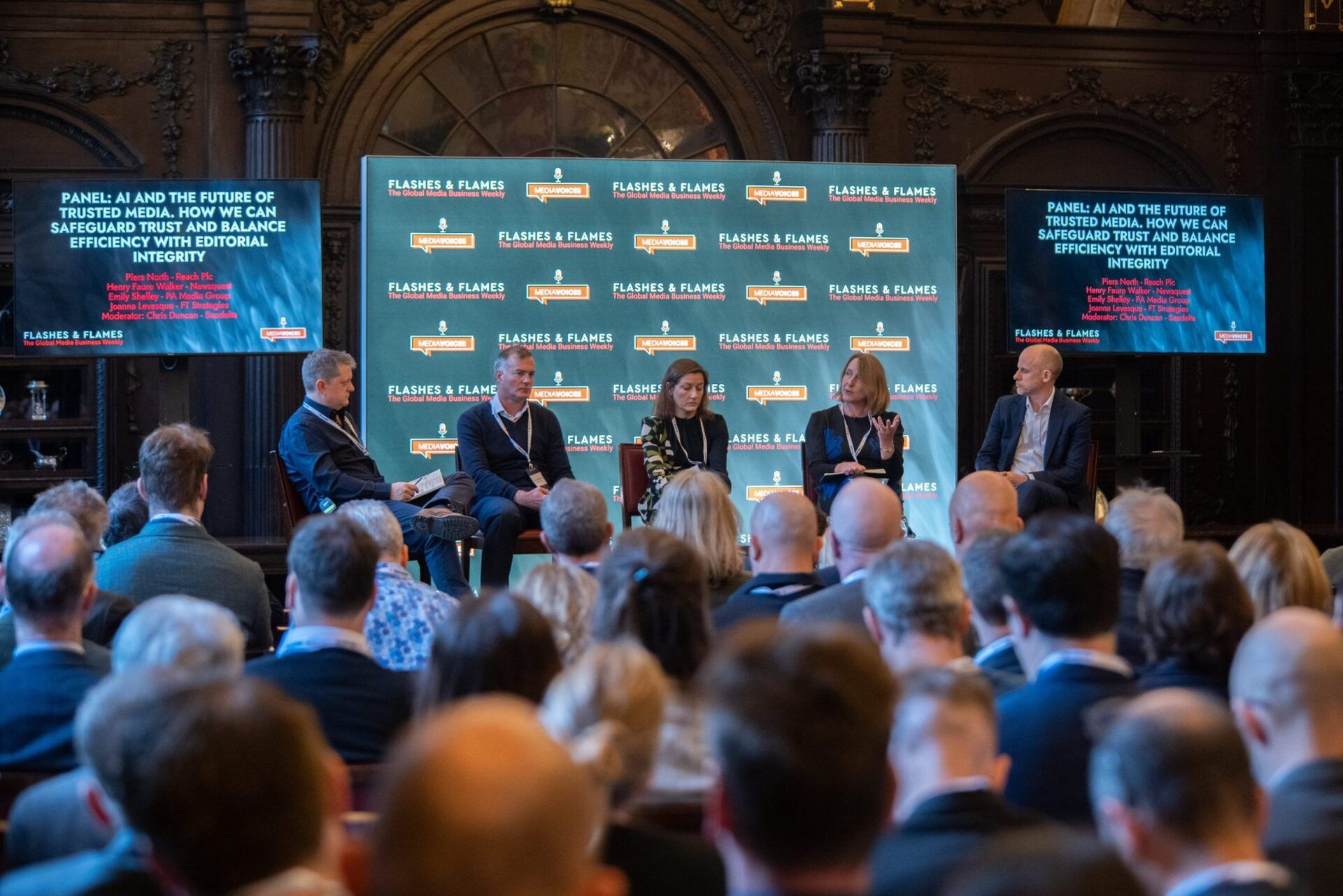
Seedelta CEO Chris Duncan; Emily Shelley, CEO of PA Media Group; Henry Faure Walker, CEO of Newsquest; Piers North, CEO of Reach plc, and Joanna Levesque, Managing Director at FT Strategies at The Definitive AI Forum. Picture by Simon Crompton-Reid, Confex Media.
Better products, faster
Joanna at FT Strategies said she has seen a tendency to rush to the efficiencies that might be possible when new technologies are introduced, “particularly for our finance colleagues,” she explained. “But I think the opportunity is also in driving engagement, driving growth.”
For her, one of the biggest benefits in AI adoption is the opportunity to develop new products quickly. “You can do targeted newsletters much faster than you could before, which is a brilliant way of driving growth. You can be faster and better.”
Piers agreed, suggesting AI can also be used to improve quality. “We do put [our journalists] under pressure for productivity, but it might be less is more. We’re trialling agentic AI to give content scores and understand where the value really lies. Is it 10 stories about subject A, or is it one story about subject B?”
Although PA doesn’t use AI in its reporting, it has used it in archive retrieval. Emily gave the example of Alamy, PA Media’s image business, classifying 420 million images to support natural language search. “We thought that would take years and years and years,” she said.
AI has also allowed PA to look at how they can better support publishers with verified content in an age of fake experts. “We’ve launched a verified-expert hub where we’ve actually spoken to people on a video call. We’ve got clips of their voice and their image. That’s free for publishers to use so that they can make sure that somebody is a genuine expert.”
No internal pushback
The conventional wisdom is that many staff fear AI disruption, but Henry said this has not been his experience at Newsquest. “I’ve been really surprised that we’ve got virtually no pushback from the newsroom.”
He saw two reasons for that, the first being the recognition that AI automation frees them up to do higher impact journalism rather than copyediting press releases. The second is that use of AI hasn’t led to any job losses.
He said: “We’ve kept true to our word – we haven’t used this to cut jobs. I think as soon as the newsrooms get a sense that we might be reducing headcount because of AI, then I think we’re in a fragile place.”
Properly implemented, AI can have a positive, transformational, impact on building sustainable business models for local news and publishing more generally. The secret to success will lie in balancing AI’s efficiencies with the long-established standards that support public trust in journalism.
“We talk about the culture of the newsrooms, and they are cultural beasts,” said Henry. “AI will change that culture in some good ways, in terms of innovation, in terms of pace, in terms of curiosity, creativity.
“But at the same time, you don’t want to lose the really positive aspects of that culture: being pedantic on facts, being ruthless, holding power to account, and challenging, and not short-cutting.”
Listen to the full session in this week’s episode of The Publisher Podcast, available wherever you find podcasts.